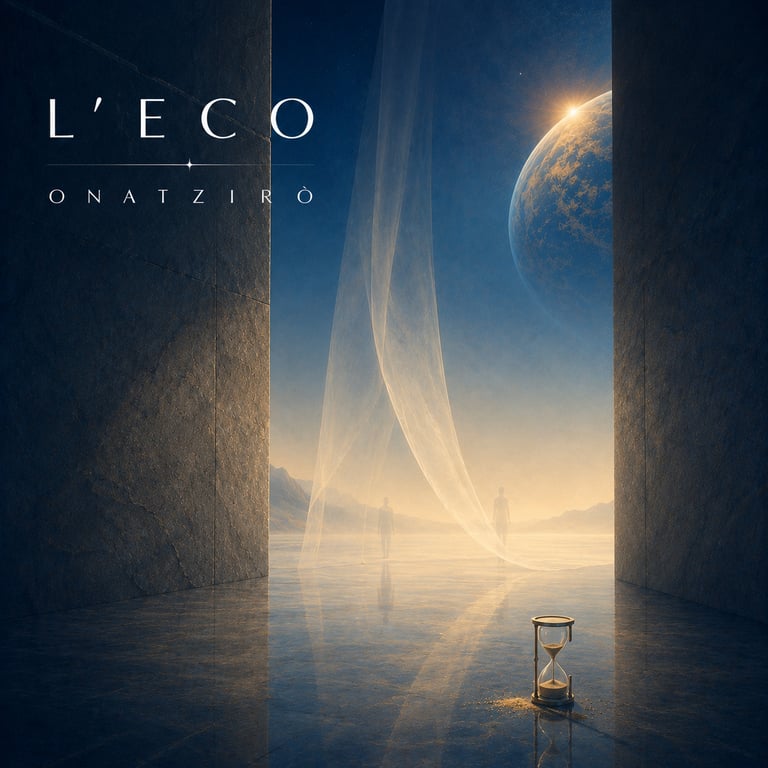
05 THE ECHO
It’s mist that keeps tomorrow out of sight,
Not a solid wall of stone,
Just a trembling veil of light.
It’s mist, it bends the sunlight as it streams,
It distorts but never hides,
Only blurs what can be seen.
No ti intendo.
I can’t make you out.
No ti intendo.
I can’t make you out.
I long for that faith that numbs us into peace,
That threatens with the abyss, then washes conscience clean.
I long for the something more that shuts all questions out,
Like a heavy curtain drawn across each nagging doubt.
No ti intendo.
I can’t make you out.
No ti intendo.
I can’t make you out.
It’s sand that has escaped the hourglass,
Each day branded by the heart as its burning hours pass.
It’s sand cast in the gears until they grind,
The question I address to the double in my mind.
No ti intendo.
I can’t make you out.
No ti intendo.
I can’t make you out.
I’d know what tomorrow was holding for me,
If I found the courage to speak honestly.
I’d know how to welcome the moment in view,
And live it completely without thinking it through.
No ti intendo.
I can’t make you out.
No ti intendo.
I can’t make you out.
It’s the echo rebounding from wall into wall,
Through the chambers of stone, but I hear nothing at all.
It’s the echo of a homeland calling her child,
The lost son who was driven away into exile.
No ti intendo.
I can’t make you out.
No ti intendo.
I can’t make you out.
No ti intendo…
I can’t make you out…
No ti intendo…
Perhaps time is not a line.
Perhaps past, present and future do not truly follow one another, but coexist within the same secret substance, separated only by a slender mist. Not a wall, not an irrevocable fracture: a shifting veil, capable at times of allowing glimmers, summons and premonitions to filter through.
The Echo moves within this uncertain threshold.
It is an attempt to listen to what rebounds from one point in time to another: a voice belonging to what has already happened, a possibility not yet fulfilled, a part of oneself left behind—or perhaps already somewhere beyond.
But truly hearing requires more than understanding.
We must stop asking thought to seal every opening. Renounce the consolation of easy certainties, cross doubt without anaesthetising it, allow ourselves to be wounded by the question until the question itself becomes a passage.
Only then can the mist bend. And what seemed distant, lost or incomprehensible begins to call again. Like a father longing to have beside him once more a son who was forced to leave.
Like an echo.
Contact
Get in touch to discuss a collaboration—or simply to satisfy your curiosity.
© 2026. All rights reserved.


