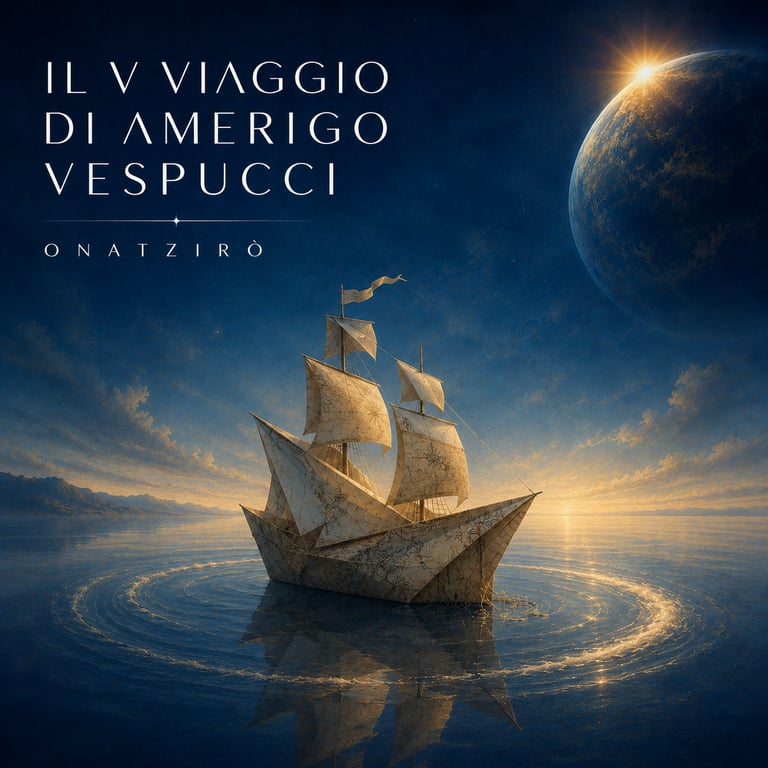
06 THE FIFTH VOYAGE OF AMERIGO VESPUCCI
A matchless thought can scarcely hold
The burden of your frame;
Your vessel, out of paper wrought,
Will bear you home again.
Tell me what you met while roaming
Endlessly from sea to sea:
Only pride dragged through the mire,
That compelled you then to flee.
So tell me, why repeat the selfsame song?
Do you never tire of circling evermore?
You run backwards from that shattered dream long gone,
Like a crayfish you retreat towards the ocean floor.
Your wounded conscience, beast of burden,
Bows beneath the load it bears;
The mainsail drawn against the boom
Can scarcely hold the air.
What was the reason that compelled you
To take flight and flee?
Why did you clutch the helm like a rifle,
Levelled at the sea?
So tell me, why repeat the selfsame song?
Do you never tire of circling evermore?
You run backwards from that shattered dream long gone,
Like a crayfish you retreat towards the ocean floor.
Of all this circling, travelling, dreaming,
You kept nothing—no, not even a sigh.
Perhaps that’s why each new tale you tell turns bitter,
And stone has settled in your eyes.
So tell me, why repeat the selfsame song?
Do you never tire of circling evermore?
You run backwards from that shattered dream long gone,
Like a crayfish you retreat towards the ocean floor.
The breath stolen from your lungs remains
Entangled in the net;
And so your final sounds resound,
As voiceless as regret.
At times it takes so very little
To leave a trace in History;
Yet you would brave the great unknown
To cloak yourself in glory.
So tell me, why repeat the selfsame song?
Do you never tire of circling evermore?
You run backwards from that shattered dream long gone,
Like a crayfish you retreat towards the ocean floor.
Amerigo Vespucci’s fifth voyage never took place. Perhaps that is precisely why it can tell us more than all the others.
It belongs neither to the chronicles nor to the routes traced upon maps. It is an imagined, inward voyage, perhaps the final landfall of a man approaching the end of his life—a man who crossed real seas, served kings, trained navigators and helped draw the new face of the world.
And before whatever time remains, every choice once made leaves behind an unanswered question.
Why set sail? Why does a banker, a merchant, a man born to reckon goods and money, decide to entrust himself to the ocean, to risk, to the unknown? What truly drives a human being to leave the shore: courage, ambition, flight, wounded pride, or the need to give one’s destiny a name?
The Fifth Voyage of Amerigo Vespucci imagines the route that no atlas could ever record: the one that leads into the conscience of a man who searched the world and, in the end, is forced to question himself.
In the lineage of the great Italian singer-songwriter tradition, the song transforms Vespucci into a living, restless figure: not merely the navigator whose name America bears, but a man who continues to wonder what price his enterprise exacted.
Because sometimes the greatest voyage is not the one that discovers new lands, but the one that compels us, with no maps left to guide us, to look into our own history.
Contact
Get in touch to discuss a collaboration—or simply to satisfy your curiosity.
© 2026. All rights reserved.


